
I’m not greeting the New Year with any resolutions. No clichés about losing weight or doing volunteer work or anything like that. I’d rather not set myself up for disappointment. Yes, you should set goals for yourself. Yes, you must have some method to measure your success. Yes, you should give yourself a deadline so that the goal is achievable. Hmm. I seem to have made the case for resolutions. Nevertheless, I say no! Instead, I shall remember all the good things from 2010, try to keep learning from all the bad, and keep reminding myself: yes, I too deserve happiness.
So it’s a new year, huh? Ok then. Let’s get working on achieving happiness, however you define it.
Happy New Year, everyone! I wish happiness for you, wherever you are.
Showing posts with label Musings. Show all posts
Showing posts with label Musings. Show all posts
Friday, 31 December 2010


Monday, 29 November 2010
I should be somewhere else
Maybe “should” is too strong a word. Ok then, I “want” to be somewhere else. But life doesn’t always turn out the way we want it to. Usually something gets in the way. A “commitment” of some kind, whether time, or money, or attention, or some combination. We all have them. Our jobs; doctor’s appointments; class schedules; mortgage payments; project meetings; and the list goes on.
So I’m sitting here wishing all these commitments could take a break, when it hits me. I get it. I know why parents always want to “spoil” their children. Forget making them happy and seeing their smiles. Forget giving them a better future or more fulfilling life. It’s about living vicariously.
When else are you unburdened by commitments that hamper your free spirit? Only as a child do you have the freedom to go through your days without a worry in the world. Before there are timesheets, before there are examinations, before there are roll calls, before there are campuses to cross, before there are teachers, before there are homework assignments, before all that - there is exploration of your world. There is you - and there is the world. There are paintbrushes and colouring books, fields to jump in and slides to go down, butterflies to chase and gardens to water, toys to play with and the boxes that substitute - all there for exploration without concern for anything but that it’s there.
So if you want to eat something specific - fries, or ice-cream, or sliced apples - it’s there. If you want to go to a mall - someone will take you. If you want to go to a park - someone will take you.
And that’s what parents should do. Take care of the commitments. It’s what you do as an adult. Protect your child from the disappointments of life. They’ll come in soon enough, those disappointments. Can’t stop that; no way to avoid it. And when those commitments get you down, live vicariously.
Take care of the commitments so someone else gets what they want and gets to live life.
So I’m sitting here wishing all these commitments could take a break, when it hits me. I get it. I know why parents always want to “spoil” their children. Forget making them happy and seeing their smiles. Forget giving them a better future or more fulfilling life. It’s about living vicariously.
When else are you unburdened by commitments that hamper your free spirit? Only as a child do you have the freedom to go through your days without a worry in the world. Before there are timesheets, before there are examinations, before there are roll calls, before there are campuses to cross, before there are teachers, before there are homework assignments, before all that - there is exploration of your world. There is you - and there is the world. There are paintbrushes and colouring books, fields to jump in and slides to go down, butterflies to chase and gardens to water, toys to play with and the boxes that substitute - all there for exploration without concern for anything but that it’s there.
So if you want to eat something specific - fries, or ice-cream, or sliced apples - it’s there. If you want to go to a mall - someone will take you. If you want to go to a park - someone will take you.
And that’s what parents should do. Take care of the commitments. It’s what you do as an adult. Protect your child from the disappointments of life. They’ll come in soon enough, those disappointments. Can’t stop that; no way to avoid it. And when those commitments get you down, live vicariously.
Take care of the commitments so someone else gets what they want and gets to live life.
Sunday, 26 September 2010
The shadow of the father
My sis sent me an sms earlier: "Dad’s on Wikipedia!" (Bored much? Hehe. Can I get my laptop back?) Soon after, there’s a short clip on TV about today in history. 10 years ago today, TiungSAT-1, Malaysia’s first microsatellite, was launched from Kazakhstan. And my dad’s picture flashed on screen. The timing of the sms and the "today in history" clip is coincidental; the Wikipedia entry is not a personal page, but just a list.
Still, it gives me pause. Nothing too mindblowing. I’ve thought about this before. It may not be a very big shadow, but there’s still a shadow cast by my father. Nothing I need to really crawl out of though. We don’t have that much in common, and I don’t operate in the same circle.
I wonder what others think though.
Still, it gives me pause. Nothing too mindblowing. I’ve thought about this before. It may not be a very big shadow, but there’s still a shadow cast by my father. Nothing I need to really crawl out of though. We don’t have that much in common, and I don’t operate in the same circle.
I wonder what others think though.
Tuesday, 20 April 2010
“Oh, we’re not friends with him any more”
I’m really curious how that conversation would go. It’s a hypothetical conversation of course. At least, as far as I’m concerned.
I once was married and now am not. I am also a few friends short.
Let’s start with two sets of friends, one mine (M), one hers (H). Then we’ll intersect them (M-I-H) for after we met. There are still members of the original sets outside the intersection. Due to the dynamics of sympathy, I have since discovered that it is no longer possible to identify the original boundaries of M and H. Hence, upon separation, we are left with {M} – {M-I-H} and {H} + {M-I-H}. There are a few rogue elements that do not obey this, but by and large, it seems to be the case.
Am I bitter about this? Once I was. Not any more.
Good thing my experience teaches me how to renew {M} as and when necessary.
I once was married and now am not. I am also a few friends short.
Let’s start with two sets of friends, one mine (M), one hers (H). Then we’ll intersect them (M-I-H) for after we met. There are still members of the original sets outside the intersection. Due to the dynamics of sympathy, I have since discovered that it is no longer possible to identify the original boundaries of M and H. Hence, upon separation, we are left with {M} – {M-I-H} and {H} + {M-I-H}. There are a few rogue elements that do not obey this, but by and large, it seems to be the case.
Am I bitter about this? Once I was. Not any more.
Good thing my experience teaches me how to renew {M} as and when necessary.
Wednesday, 17 March 2010
Things you’d love to say on the LRT
… but probably won’t. (Bukankah kita prihatin?) In no particular order:
Would an “excuse me” prefixing those statements make it less caustic, or is it still overstepping bounds anyway?
- “That’s a lovely baju kurung, but I think you have way too many chemicals in your hair.” whisper: cos I can smell it from here
- “That’s a nice big backpack you have there; you could probably kill a dog with that bag if you dropped it.” whisper: I know cos I’m still reeling from that shove in the chest
- “Is there a water shortage in your area, or are you just allergic to water?” whisper: (yes, you guessed it) cos I can smell you from all the way over here
Would an “excuse me” prefixing those statements make it less caustic, or is it still overstepping bounds anyway?
Wednesday, 18 November 2009
Divorce statistics in Malaysia
It’s an oft-cited “statistic” (at least in Western countries): 1 in 2 marriages end in divorce. It’s a result of the weakening of the “traditional” family unit. People are more casual about their romantic relationships, which leads to lack of commitment to see through a lasting marriage.
How true is it though? Or more appropriately, does it apply to Malaysia?
Divorce as a topic has been in the news in the past few weeks. We have read about a growing concern about the local divorce rate. We discovered that one of the state governments has a small but successful program to sponsor a second honeymoon for couples thinking of heading to divorce. Based on the success of that program, they were considering expanding the program. Then we heard of another proposal for enrolling husbands in some sort of grooming course to better their appeal to their wives.
Strange and fantastic news indeed. So what feeds this fear on divorce rates? Is there some basis for this fear? Just how bad a beating is the institution of marriage suffering in Malaysia?
To do my research, I didn’t go for a primary source, such as the National Registration Department and/or Jabatan Kemajuan Islam Malaysia (JAKIM), although my source did rely on those two sources. After searching online, I found a paper researched by Samuel Chan Hsin Chien and Mohamed Sarif Mustaffa, for the Faculty of Education, University Technology Malaysia, Johor. The paper’s main purpose was to discover the situation of divorce in Malaysia.
From the two primary sources mentioned above, the authors of the research paper have obtained statistics on registered marriages and divorces amongst Muslims (from JAKIM) and Non-Muslims (from NRD) for the years 2000 to 2005, with a breakdown by state. The authors reached two conclusions from the data gathered.
First, although the divorce rate has grown moderately over the five year period from 9.88% to 12.83%, this is still small compared to some developed countries such as the US (51%, 1998), Australia (49%, 1996), Canada (48%, 1995), and Germany (44%, 1997). I don’t know the source of their statistics for those countries, but it does fit the standard notion that 1 in 2 marriages end in divorce. Unfortunately, those are also old statistics, so the situation may have changed now. No matter. It’s not the direction I’ll be looking at.
The second conclusion the authors reached is that the divorce rate amongst the Muslims is keeping proportionate to the increasing number of marriages, but the situation is not the same with the Non-Muslims. With the Non-Muslims, the number of marriages actually declined, while the number of divorces doubled. This led to an increasing divorce rate amongst the Non-Muslims, from 2.63% to 7.19%. Whether this is a trend that continued beyond 2005 and still continues today might be worth examining in detail. Nevertheless, the divorce rate amongst the Muslims is still significantly higher, increasing from 14.71% to 15.51%.
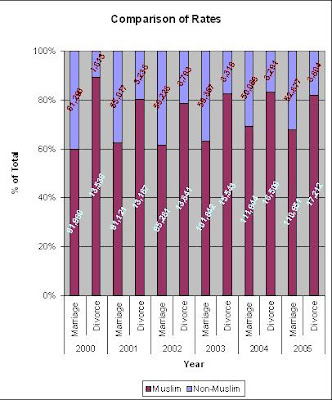
Playing around with the data, I came up with a graph comparing the split between Muslim/Non-Muslim marriages and divorces. It’s instructive to note that demographically, the ratio in the population is roughly 60%/40% Muslim/Non-Muslim. Looking back at the graph, it appears that a larger portion of Malaysia’s Muslim population is getting married as compared to the Non-Muslim population. Still, more than 80% of the divorces in the country were between Muslim couples. Although the gap between share of marriages and share of divorces is shrinking, that’s still about 15 points higher than the ratio of marriages between Muslims and Non-Muslims.

An interesting side story arises once we examine the data breakdown by state. Considering the average rate of divorce over the years examined, we discover that the top three worst states in descending order are Selangor, KL, and Penang, all with an average divorce rate above 15%. The three best states in ascending order are Sabah, Kedah, and Johor, incidentally the only states together with Sarawak and Negeri Sembilan with divorce rates below the national average of 11.55%. So Sabahans have the best marriages, and Selangorites have the worst? I’m not going to touch that topic with a ten foot pole.
So what do the authors make of this state of affairs? What are the major drivers of divorce in Malaysia? Unfortunately, the paper does not delve into this issue, but instead cites “numerous foreign literatures” (sic) as stating that the top three factors that influence divorce are “1) infidelity, 2) no longer in love, and 3) emotional problems.” It’s very likely that those factors are inter-related, and possibly so with other factors as well.
Are these the main factors that play a role in the Malaysian context? I don’t know. I have not located any research that studies this. But if they do, does that mean those state programs we read about recently are on the right track?
I should take this opportunity to note that I, too, am now a statistic. I join the ranks of the many faceless ones people always hear about. Those supposed sad cases, or scandals. Now I know, there is nothing to be either proud or ashamed about. It just is. Adjustments are made. Life goes on. And no, I’m not interested in participating in a survey. Not now at least.
How true is it though? Or more appropriately, does it apply to Malaysia?
Divorce as a topic has been in the news in the past few weeks. We have read about a growing concern about the local divorce rate. We discovered that one of the state governments has a small but successful program to sponsor a second honeymoon for couples thinking of heading to divorce. Based on the success of that program, they were considering expanding the program. Then we heard of another proposal for enrolling husbands in some sort of grooming course to better their appeal to their wives.
Strange and fantastic news indeed. So what feeds this fear on divorce rates? Is there some basis for this fear? Just how bad a beating is the institution of marriage suffering in Malaysia?
To do my research, I didn’t go for a primary source, such as the National Registration Department and/or Jabatan Kemajuan Islam Malaysia (JAKIM), although my source did rely on those two sources. After searching online, I found a paper researched by Samuel Chan Hsin Chien and Mohamed Sarif Mustaffa, for the Faculty of Education, University Technology Malaysia, Johor. The paper’s main purpose was to discover the situation of divorce in Malaysia.
From the two primary sources mentioned above, the authors of the research paper have obtained statistics on registered marriages and divorces amongst Muslims (from JAKIM) and Non-Muslims (from NRD) for the years 2000 to 2005, with a breakdown by state. The authors reached two conclusions from the data gathered.
First, although the divorce rate has grown moderately over the five year period from 9.88% to 12.83%, this is still small compared to some developed countries such as the US (51%, 1998), Australia (49%, 1996), Canada (48%, 1995), and Germany (44%, 1997). I don’t know the source of their statistics for those countries, but it does fit the standard notion that 1 in 2 marriages end in divorce. Unfortunately, those are also old statistics, so the situation may have changed now. No matter. It’s not the direction I’ll be looking at.
The second conclusion the authors reached is that the divorce rate amongst the Muslims is keeping proportionate to the increasing number of marriages, but the situation is not the same with the Non-Muslims. With the Non-Muslims, the number of marriages actually declined, while the number of divorces doubled. This led to an increasing divorce rate amongst the Non-Muslims, from 2.63% to 7.19%. Whether this is a trend that continued beyond 2005 and still continues today might be worth examining in detail. Nevertheless, the divorce rate amongst the Muslims is still significantly higher, increasing from 14.71% to 15.51%.

Playing around with the data, I came up with a graph comparing the split between Muslim/Non-Muslim marriages and divorces. It’s instructive to note that demographically, the ratio in the population is roughly 60%/40% Muslim/Non-Muslim. Looking back at the graph, it appears that a larger portion of Malaysia’s Muslim population is getting married as compared to the Non-Muslim population. Still, more than 80% of the divorces in the country were between Muslim couples. Although the gap between share of marriages and share of divorces is shrinking, that’s still about 15 points higher than the ratio of marriages between Muslims and Non-Muslims.

An interesting side story arises once we examine the data breakdown by state. Considering the average rate of divorce over the years examined, we discover that the top three worst states in descending order are Selangor, KL, and Penang, all with an average divorce rate above 15%. The three best states in ascending order are Sabah, Kedah, and Johor, incidentally the only states together with Sarawak and Negeri Sembilan with divorce rates below the national average of 11.55%. So Sabahans have the best marriages, and Selangorites have the worst? I’m not going to touch that topic with a ten foot pole.
So what do the authors make of this state of affairs? What are the major drivers of divorce in Malaysia? Unfortunately, the paper does not delve into this issue, but instead cites “numerous foreign literatures” (sic) as stating that the top three factors that influence divorce are “1) infidelity, 2) no longer in love, and 3) emotional problems.” It’s very likely that those factors are inter-related, and possibly so with other factors as well.
Are these the main factors that play a role in the Malaysian context? I don’t know. I have not located any research that studies this. But if they do, does that mean those state programs we read about recently are on the right track?
I should take this opportunity to note that I, too, am now a statistic. I join the ranks of the many faceless ones people always hear about. Those supposed sad cases, or scandals. Now I know, there is nothing to be either proud or ashamed about. It just is. Adjustments are made. Life goes on. And no, I’m not interested in participating in a survey. Not now at least.
Tuesday, 29 September 2009
Let’s talk about friendship
The October 2009 company newsletter – the newsletter’s second issue, following the inaugural September 2009 issue – will have a theme of “Friendship”. The Editorial Board has invited staff to contribute an article of not more than 300 words on the topic. I have two reasons for not submitting to the newsletter. First, I’d rather write to a wider audience anyway. And second, the deadline’s passed. Hehe.
It’s a good topic for the internal company newsletter, especially since the majority of the staff is in Dubai, separated from family. Friendships, especially workplace friendships, take on a whole new significance for them.
“You can’t choose your family, but you can choose your friends.” Our friends, then, are a reflection of us. After all, if you choose your friends, then your selection must say something about your priorities and personality. Why would you choose a friend who is incompatible or only serves to introduce aggravation and grief into your life? And yet, we need variety. How would we discover anything if all viewpoints we encounter reflect only our own thoughts? Good thing then that we don’t have complete control over our friends.
There are many flavours of friends we collect in our lives. There are those long-term kindergarten friends, the ones we grew up with in the neighbourhood, and have maintained a relationship over the ages. It’s possible this friendship has morphed over the years, but some bonds really do last. The same can be said of all the school friends we make, from grade school to middle school, and onto high school. These are the people we spent the majority of our time with during our formative years, in a feedback loop as we formed our unique personalities. A select few will graduate with us to adult life, but most will fall by the wayside as lives separate, geographically, spiritually, philosophically, politically.
Friendship in adult life gets more complicated, and usually more fulfilling. Your university friends are the ones most likely to last your lifetime. These are the friends who slaved over assignments and reports with you, who participated in clubs and associations with you, who ranted against professors with you, who partied with you, who cheered at sporting events with you. For most people university was the first period away from home, so it was a big deal. You had to be independent, and were going through that experience with others who were also in the same boat. Some people were insular during this period, only making friends from those in the same course as them. Others threw the net wider, and made friends studying other disciplines. But your classmates from freshman year are most likely to be your closest friends.
And then there are the friend “also-rans”. There are the acquaintances at work, some of whom genuinely became friends and stuck around in your life even if you moved jobs. There are the friends you made online, some of whom you even meet IRL. This last group is probably the only group of friends you actively sought out, and not people who evolved into friends through circumstance. However, most of them would remain as acquaintances, or fellow hobbyists.
The other friends we have to ask ourselves about, to be certain they are friends, are the ones we meet through circumstance. These are from all those other groups; the friends from school, from work, and so on. Brought together by our situations, we sometimes find out that we’re only friends as far as we remain in that condition. Move schools, swap courses, move to another country, change jobs, and we may find that we no longer connect with our old friends.
“Friends come and go, but true friends always stay.”
True friends are those who stick with you, even after circumstances change. Don’t belittle “only friends” though; they’re valuable because they lend you a social life, and they introduce that needed variety into your life. Your circle of true friends is probably smaller though. The Internet and social networking doesn’t change this dynamic. Keeping in touch with your friends does not equate to connecting with them.
People change. People grow. Your true friends will grow with you, and accept you as you change. Treasure these people.
It’s a good topic for the internal company newsletter, especially since the majority of the staff is in Dubai, separated from family. Friendships, especially workplace friendships, take on a whole new significance for them.
“You can’t choose your family, but you can choose your friends.” Our friends, then, are a reflection of us. After all, if you choose your friends, then your selection must say something about your priorities and personality. Why would you choose a friend who is incompatible or only serves to introduce aggravation and grief into your life? And yet, we need variety. How would we discover anything if all viewpoints we encounter reflect only our own thoughts? Good thing then that we don’t have complete control over our friends.
There are many flavours of friends we collect in our lives. There are those long-term kindergarten friends, the ones we grew up with in the neighbourhood, and have maintained a relationship over the ages. It’s possible this friendship has morphed over the years, but some bonds really do last. The same can be said of all the school friends we make, from grade school to middle school, and onto high school. These are the people we spent the majority of our time with during our formative years, in a feedback loop as we formed our unique personalities. A select few will graduate with us to adult life, but most will fall by the wayside as lives separate, geographically, spiritually, philosophically, politically.
Friendship in adult life gets more complicated, and usually more fulfilling. Your university friends are the ones most likely to last your lifetime. These are the friends who slaved over assignments and reports with you, who participated in clubs and associations with you, who ranted against professors with you, who partied with you, who cheered at sporting events with you. For most people university was the first period away from home, so it was a big deal. You had to be independent, and were going through that experience with others who were also in the same boat. Some people were insular during this period, only making friends from those in the same course as them. Others threw the net wider, and made friends studying other disciplines. But your classmates from freshman year are most likely to be your closest friends.
And then there are the friend “also-rans”. There are the acquaintances at work, some of whom genuinely became friends and stuck around in your life even if you moved jobs. There are the friends you made online, some of whom you even meet IRL. This last group is probably the only group of friends you actively sought out, and not people who evolved into friends through circumstance. However, most of them would remain as acquaintances, or fellow hobbyists.
The other friends we have to ask ourselves about, to be certain they are friends, are the ones we meet through circumstance. These are from all those other groups; the friends from school, from work, and so on. Brought together by our situations, we sometimes find out that we’re only friends as far as we remain in that condition. Move schools, swap courses, move to another country, change jobs, and we may find that we no longer connect with our old friends.
“Friends come and go, but true friends always stay.”
True friends are those who stick with you, even after circumstances change. Don’t belittle “only friends” though; they’re valuable because they lend you a social life, and they introduce that needed variety into your life. Your circle of true friends is probably smaller though. The Internet and social networking doesn’t change this dynamic. Keeping in touch with your friends does not equate to connecting with them.
People change. People grow. Your true friends will grow with you, and accept you as you change. Treasure these people.
Thursday, 17 September 2009
Who still sends Hari Raya cards?
I have received one greeting card this year, and that’s a standard issue card that KLCC Property Holdings Bhd provides to all its directors. One such director then gave cards out to all the Muslims at our office.
The last time I gave out cards was 5 or 6 years ago. Actually went out to buy some cards, and then addressed them to a small group of close friends. I actually remember one year getting cards, addressing them, and then forgetting to deliver them! Not all, but some. That was probably the catalyst that got me to join the crowd with SMS greetings instead. They were instant, you could be sure the recipient got them in time, and it was easy to make sure you sent a greeting to everyone. I’ve always found ASCII art captivating, the way simple, repetitive icons can combine to paint a picture. I sometimes re-sent some of the more interesting SMS’ that I received.
The advent of social networking gives us the latest iteration in the evolution of the Hari Raya greeting. You have a few options. You could tweet a greeting to all your followers; or set a new Facebook status message; or for something more flashy, post a picture of a greeting card and tag all your friends. Heck, with this last method you could even segregate your greetings. One picture per group of friends!
I’ll admit that this year, as usual, I don’t have any cards to give out. It’s not that I don’t care; I have a much smaller circle now anyway. But I’m afraid of being thought gauche for sending out SMS greetings, although that would still reach (slightly) more people than an FB status greeting.
I’ll settle for a multi-pronged approach. To those who really matter, you’ll hear it from my lips. To others, you’ll read my words. The thought remains the same. May Allah accept your honest fast. Eid Mubarak! Selamat Hari Raya Aidilfitri! Maaf Zahir dan Batin.
And drive safely on the roads.
The last time I gave out cards was 5 or 6 years ago. Actually went out to buy some cards, and then addressed them to a small group of close friends. I actually remember one year getting cards, addressing them, and then forgetting to deliver them! Not all, but some. That was probably the catalyst that got me to join the crowd with SMS greetings instead. They were instant, you could be sure the recipient got them in time, and it was easy to make sure you sent a greeting to everyone. I’ve always found ASCII art captivating, the way simple, repetitive icons can combine to paint a picture. I sometimes re-sent some of the more interesting SMS’ that I received.
The advent of social networking gives us the latest iteration in the evolution of the Hari Raya greeting. You have a few options. You could tweet a greeting to all your followers; or set a new Facebook status message; or for something more flashy, post a picture of a greeting card and tag all your friends. Heck, with this last method you could even segregate your greetings. One picture per group of friends!
I’ll admit that this year, as usual, I don’t have any cards to give out. It’s not that I don’t care; I have a much smaller circle now anyway. But I’m afraid of being thought gauche for sending out SMS greetings, although that would still reach (slightly) more people than an FB status greeting.
I’ll settle for a multi-pronged approach. To those who really matter, you’ll hear it from my lips. To others, you’ll read my words. The thought remains the same. May Allah accept your honest fast. Eid Mubarak! Selamat Hari Raya Aidilfitri! Maaf Zahir dan Batin.
And drive safely on the roads.
Friday, 14 August 2009
Tagging photos
Back in the day, before digital cameras, most people would whip out cameras only at special events or while on holiday. That made it easy to remember when and why pictures were taken, since you usually got them in batches of about 30 prints.
And then came the digital camera, which ushered in a whole new culture of photography. With instant results, and no need for expensive developing unless you wanted to, there was no “wastage” factor to consider when snapping a photo. There wasn’t any film to “save” for those special moments. Any moment could be a special moment.
In the beginning, of course, the one thing you were limited by was memory space. But with the ability to instantly review your photo, you could keep on snapping and delete those pictures that didn’t turn out well, ensuring that you had enough memory for the next picture. Now even that limitation is gone, with huge memory cards filling our digital cameras.
Has that led to a deterioration of standards? Maybe.
Has that opened the door to tons of photos you can’t even place any more? Probably.
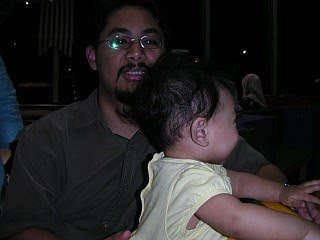
Take the following picture, taken three years ago. A’isyah’s having fun. I have no idea where we are. Hehe. Just perfect.
I guess I should start tagging my photos.
And then came the digital camera, which ushered in a whole new culture of photography. With instant results, and no need for expensive developing unless you wanted to, there was no “wastage” factor to consider when snapping a photo. There wasn’t any film to “save” for those special moments. Any moment could be a special moment.
In the beginning, of course, the one thing you were limited by was memory space. But with the ability to instantly review your photo, you could keep on snapping and delete those pictures that didn’t turn out well, ensuring that you had enough memory for the next picture. Now even that limitation is gone, with huge memory cards filling our digital cameras.
Has that led to a deterioration of standards? Maybe.
Has that opened the door to tons of photos you can’t even place any more? Probably.
Take the following picture, taken three years ago. A’isyah’s having fun. I have no idea where we are. Hehe. Just perfect.

I guess I should start tagging my photos.
Friday, 31 July 2009
Tips from The Happiness Project for turning around a Bad Day
My last post was about a bad good day, so I guess it’s appropriate that the follow-up post is about a good bad day. Everyone has bad days. Maybe you had an argument with someone and that fouled your mood for the rest of the day. Maybe something didn’t turn out the way you wanted it to. A lot of times you can’t change the outcome of those events, no matter what you try.
What you can change, however, is how you let those events affect you.
Today I read a post at The Happiness Project blog about a good bad day. The author presents a total of nine tips to deal with bad days and how to turn them around to be good bad days. It’s all about how to make sure that the bad day doesn’t get you down too much.
Two tips that stand out for me are: “do something nice for someone else” and “act the way (you) want to feel”. I really do believe that kindness is its own reward. Don’t do good expecting to be rewarded for it, or even recognized for it. That’s when you get the real reward: feeling good. And when you act happy, smile, mix with other people, share light-hearted moments with others, you’ll start to feel happy. It just rubs off on you.
Go here to read the full list of 9 tips. I’d also recommend following the blog, cos it’s a fountain of good advice to manage happiness.
Here’s to happiness! May we all have more of it.
What you can change, however, is how you let those events affect you.
Today I read a post at The Happiness Project blog about a good bad day. The author presents a total of nine tips to deal with bad days and how to turn them around to be good bad days. It’s all about how to make sure that the bad day doesn’t get you down too much.
Two tips that stand out for me are: “do something nice for someone else” and “act the way (you) want to feel”. I really do believe that kindness is its own reward. Don’t do good expecting to be rewarded for it, or even recognized for it. That’s when you get the real reward: feeling good. And when you act happy, smile, mix with other people, share light-hearted moments with others, you’ll start to feel happy. It just rubs off on you.
Go here to read the full list of 9 tips. I’d also recommend following the blog, cos it’s a fountain of good advice to manage happiness.
Here’s to happiness! May we all have more of it.
Wednesday, 8 July 2009
A bad good day
What the heck is a bad good day, you ask? Look at it this way: your experience of a day depends on your expectations for that day. So your assessment of whether it was a good day or a bad day depends on how the events of the day meet your expectations. Two persons experiencing the same events on the same day will very likely have different reactions to those events, and hence judge the day as good or bad depending on their point of view.
That’s the first part. Then there’s also the fact that two persons could have wildly different experiences on the same day, so their memory of that day depends on their own personal experience. That’s all too common. Just because you had a good day, doesn’t mean someone else couldn’t have had a bad day. That only makes sense. But sometimes we forget that.
Sometimes, we’re thrilled about our day, and overlook that our friend may have just had a bad day. So maybe we become insensitive. And what if we were in their shoes? What if we had a bad day, and our friend had a great day, and they’re sharing their joy with us? Would we want them to stuff it? Would we resent them their good day? A good friend shouldn’t dampen their friend’s happiness, even if they can’t share in it.
So what if we’re sensitive to the other party’s feelings? What if we know that our friend had a bad day? Maybe we feel bad about having a good day. Maybe we feel a little guilt at being happy.
And maybe we can’t bring ourselves to being happy.
That is a bad good day.
That’s the first part. Then there’s also the fact that two persons could have wildly different experiences on the same day, so their memory of that day depends on their own personal experience. That’s all too common. Just because you had a good day, doesn’t mean someone else couldn’t have had a bad day. That only makes sense. But sometimes we forget that.
Sometimes, we’re thrilled about our day, and overlook that our friend may have just had a bad day. So maybe we become insensitive. And what if we were in their shoes? What if we had a bad day, and our friend had a great day, and they’re sharing their joy with us? Would we want them to stuff it? Would we resent them their good day? A good friend shouldn’t dampen their friend’s happiness, even if they can’t share in it.
So what if we’re sensitive to the other party’s feelings? What if we know that our friend had a bad day? Maybe we feel bad about having a good day. Maybe we feel a little guilt at being happy.
And maybe we can’t bring ourselves to being happy.
That is a bad good day.
Tuesday, 7 April 2009
Opinion and truth
When does one’s opinion become the truth?
What if someone believed “something”? What if some other people (second parties) confirmed the first party’s belief in that “something”? Can we consider it truth? Verifiable? What if that “something” concerned another party’s motives? What if there is perceived motive to deceive the first party? Should we bother to consider the assertions of the third party? To another group, the fourth party, what is the truth? Would that not rely on their allegiances, if any, to the other parties?
For how do you verify motives, when they deal with the subject of emotions?
Look to their actions then.
What if someone believed “something”? What if some other people (second parties) confirmed the first party’s belief in that “something”? Can we consider it truth? Verifiable? What if that “something” concerned another party’s motives? What if there is perceived motive to deceive the first party? Should we bother to consider the assertions of the third party? To another group, the fourth party, what is the truth? Would that not rely on their allegiances, if any, to the other parties?
For how do you verify motives, when they deal with the subject of emotions?
Look to their actions then.
Subscribe to:
Posts (Atom)